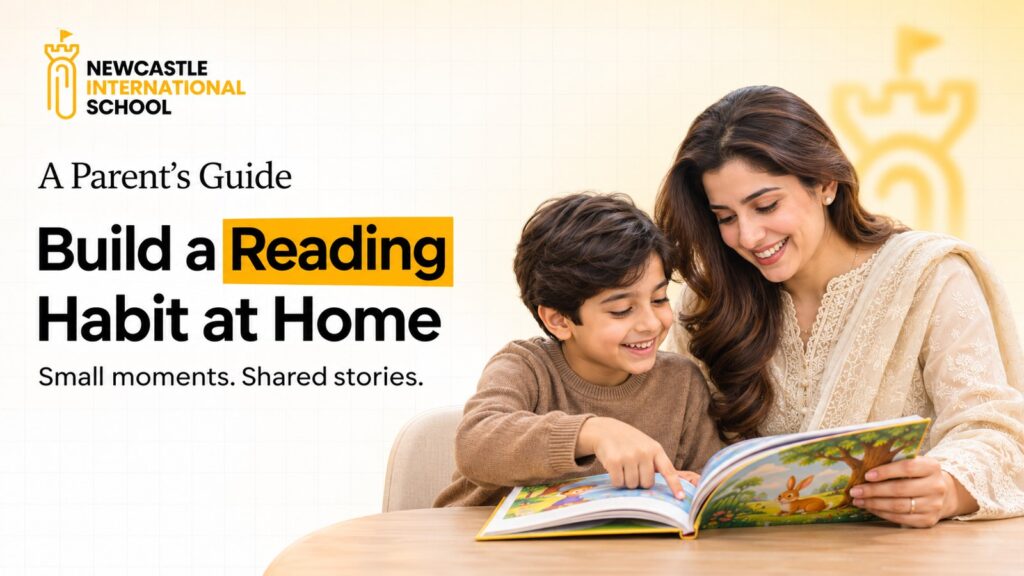
How to Build a Reading Habit at Home: A Guide for Lahore Parents
A favourite story after dinner. A recipe read together on Sunday. A child explaining why a character made a surprising choice. A reading habit at home can begin with small moments like these.
For families in Lahore, the practical question is often where reading fits between school, travel, meals and family time. Start with a short, enjoyable routine that your child wants to return to. You do not need a separate study room, an expensive collection of books or a daily worksheet.
This guide focuses on early years and primary-age children. Use the examples as a starting point and ask your child’s teacher how home reading can support their current learning.
What does a useful reading routine look like?
Choose something your child is interested in, sit together at a manageable time, and leave space for conversation. The Education Endowment Foundation’s guidance explains that early reading involves both recognising written words and understanding language. Sharing a story supports discussion and understanding; children also need teaching that helps them read words accurately. Read the EEF’s early literacy guidance.
A helpful question at the end is, “Would my child like to do this again?” Completing a set number of pages can wait while you establish the routine.
1. Start with a time you can repeat
Try a brief reading moment after a familiar part of the day: after an afternoon snack, before bedtime or while a younger sibling settles down. As a practical starting point, you could try five to ten minutes and adjust to your child’s attention and interest. This is a suggested routine, not a research-based minimum or a school requirement.
Keep one or two choices within reach. A small basket beside the sofa is enough. If an evening becomes busy, resume at the next convenient moment without adding a catch-up task.
Try tonight: “After we tidy the table, shall we read the animal book or the story about the train?”
2. Let your child help choose the reading
Offer a small choice rather than a large pile. One child may choose a funny picture book; another may prefer a page about space, a comic or instructions for making something. The EEF’s home-reading tips include everyday materials such as recipes and instructions alongside books.
For example, a child who enjoys helping in the kitchen could read the name of a dish with you and locate an ingredient in the recipe. A child interested in buses could choose a transport book. Ask the teacher which texts are suitable for independent practice and which are better enjoyed with adult help.
3. Read together without turning each page into a test
You can read aloud while your child listens, take turns where appropriate, or talk about the illustrations before beginning. Pause occasionally for a genuine conversation. You do not need to ask a question after every sentence.
The EEF’s guidance on shared book talk encourages adults to listen to children’s ideas, discuss possible events, revisit what happened and connect reading with familiar experiences.
Here are three prompts to try across different reading sessions:
- Before reading: “The window is open on the cover. What might be happening inside?”
- During reading: “You noticed the missing shoe. Show me where you spotted it.”
- After reading: “If we could ask the character one question, what would you ask?”
Listen to the answer before adding another question. If your child wants to enjoy the next page, continue the story.
4. Agree with the teacher how to help with difficult words
Ask which reading skills your child is practising and how the school would like you to respond when a word is difficult. If the class is using phonics, request an example of the sounds and blending approach being taught so your support is consistent.
When a book is beyond your child’s independent reading level, you can read it aloud and enjoy its ideas together. For practice with word reading, ask the teacher for a suitable text. These are two useful conversations to have separately: what your child enjoys hearing, and what they can currently read with appropriate support.
A useful message to the teacher: “We enjoyed the story together, but my child needed help reading several words on each page. Which book would you suggest for practice?”
5. Make the routine work for your family
If your household uses Urdu, Punjabi, English or another language, tell the teacher what feels comfortable for shared reading and ask for suitable recommendations. You could discuss a picture in the language your family uses naturally, then ask how to support the vocabulary being introduced at school.
A parent, grandparent or older sibling can be the reading partner. Decide who is available rather than making the routine depend on one busy person. If you are unsure of an English word, note it and check it together later; the shared moment does not need to stop.
A flexible seven-day reading plan
This is an optional set of ideas to adapt, repeat or spread over more than a week. There is no completion score.
- Day 1 — Choose together. Select a book and decide where you would like to sit.
- Day 2 — Notice a detail. Let your child show you something interesting in a picture or passage.
- Day 3 — Return to a favourite. Invite your child to choose a page they want to hear again.
- Day 4 — Follow an interest. Find a short piece about something your child has asked about.
- Day 5 — Share the choice. Ask your child which family member they would like to read with.
- Day 6 — Use reading in an activity. Read a recipe step or simple game instruction together.
- Day 7 — Review the routine. Ask which moment was enjoyable and what you should choose next.
Keep any notes simple: “Wanted the same story again” or “Asked what this word meant.” Bring a specific example to the next teacher conversation if you would like advice.
How does home reading fit NCIS’s balanced approach?
At Newcastle International School in Khayaban-e-Ameen, Lahore, our published approach emphasises keeping essential books at school and making home assignments purposeful and manageable. Enjoying a story together can fit around family life without becoming an additional homework schedule. Read more about NCIS’s balanced approach to learning.
When you speak with the school, ask how reading is taught in your child’s class, which materials are recommended at home and how to share questions about progress. Follow the guidance provided for your child’s stage.
Questions parents often ask
Do we need to buy a new book every week?
No new purchase is needed to begin this suggested routine. Start with suitable reading you already have, revisit favourites, and ask the teacher about recommended borrowing or reading options.
What if my child wants the same story repeatedly?
You can revisit it. Offer a different choice occasionally, and let your child show you the parts they enjoy. If you need a broader range of practice texts, ask the teacher for recommendations.
Should we stop reading aloud once my child can read independently?
You can continue sharing books if your child enjoys it. Ask whether they would prefer to listen, take turns or discuss something they have read on their own.
What if reading regularly feels difficult?
Describe what you notice to the teacher: which text you tried, where your child needed help and how the session felt. Ask for a manageable next step rather than increasing the workload automatically.
Talk to NCIS about your child’s learning
During a campus visit, bring one or two questions about reading, classroom learning and the support that suits your child’s stage. You can request a school tour or contact NCIS Lahore to begin the conversation.
Newcastle International School, Lahore
Pine Avenue, Block B, Khayaban-e-Ameen, Lahore
0339 6247547
Published 19 November 2026. The weekly plan and sample conversations are practical suggestions for families; ask your child’s teacher for guidance on reading materials and teaching methods.